Food and Beverage
In-Depth Applications of Air Compressors in Food and Beverage Production
In food and beverage production, compressed air often comes into direct contact with food raw materials, semi-finished or finished products, or is used for power drive in key aseptic processes—this is the core characteristic that distinguishes it from industrial-grade air compressors.
Cleanliness is the primary bottom line: compressed air must strictly comply with food-grade standards to prevent contaminants such as oil, water, particulates and microorganisms from mixing in. Otherwise, it may lead to product deterioration, peculiar smell, shortened shelf life and even food safety accidents.
- Stability is directly related to production continuity. Most food and beverage production lines operate 24 hours a day without interruption, so screw air compressors need to continuously output compressed air with stable pressure and flow. This avoids problems such as insufficient filling accuracy, poor packaging sealing and interrupted material conveying caused by air pressure fluctuations, ensuring a smooth and controllable production process.
- Energy efficiency is associated with production cost control. Compressed air production consumes high energy, with only 8-10% of the input energy converted into usable terminal energy. Therefore, selecting high-efficiency and energy-saving air compressors, combined with waste heat recovery, frequency conversion control and other technologies, can effectively reduce the enterprise’s energy consumption costs and achieve green production.
Key Selection Points and Development Trends of Air Compressors in the Food and Beverage Industry
- Prioritize the selection of oil-free air compressors: The selection direction varies according to whether compressed air is in direct contact with food.
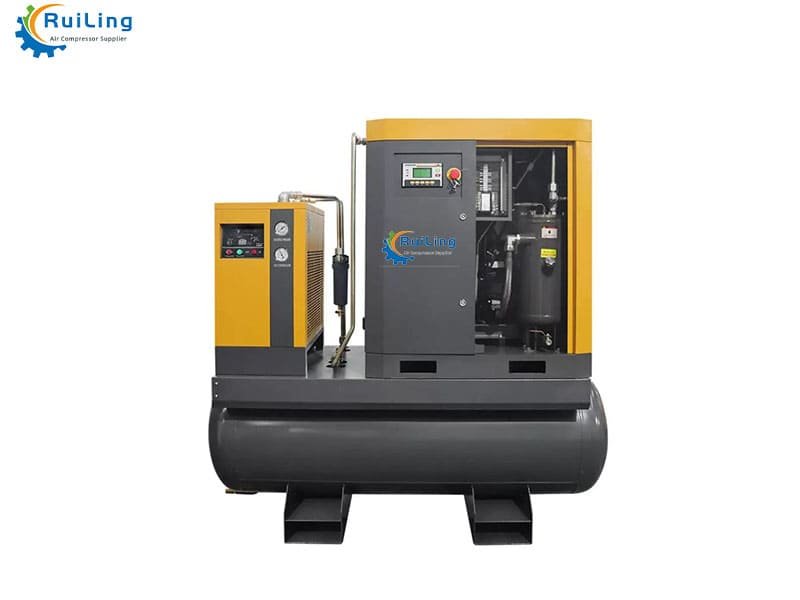
- Equip with a complete post-treatment system: Regardless of the model selected, it is necessary to match drying equipment and a three-stage filtration system to remove moisture, particulates, oil vapor and peculiar smells from compressed air. At the same time, replace filter elements regularly to ensure the air quality meets the standards continuously.
- Emphasize stability and adaptability: Select air compressors with suitable pressure and flow according to production scale and air demand to ensure stable air pressure and avoid production impacts caused by fluctuations.
- Prioritize energy-saving models: Frequency conversion air compressors can automatically adjust the rotation speed according to air demand, avoiding no-load operation and reducing energy consumption.
Development Trends: From raw material conveying to finished product packaging, from aseptic processing to fresh-keeping storage and transportation, air compressors are deeply integrated into every link of food and beverage production with their clean, stable and efficient power support, becoming core equipment for ensuring food safety, improving production efficiency and optimizing product quality. With the continuous improvement of food and beverage industry’s requirements for safety and quality, and the accelerated transformation towards intelligence and greenization, air compressors will usher in greater development opportunities. In the future, they will be upgraded towards higher cleanliness, better energy efficiency and greater intelligence, continuously empowering the high-quality development of the food and beverage industry, guarding the safety and freshness of every food product, and helping enterprises achieve the development goals of quality improvement, efficiency enhancement and cost reduction.