
Food manufacturers face unique challenges that most industries never encounter. Every piece of equipment must meet strict hygiene standards. Every process must protect product safety. Every component must operate reliably through long production shifts. Screw Air Compressors have become the go-to solution for food production because they address all of these demands simultaneously. They deliver continuous, pulse-free airflow, operate reliably under heavy use, and—when specified correctly—provide the oil-free air that food safety regulations require.
Let us explore why this technology has become essential in food processing facilities worldwide.
Why Compressed Air Matters in Food Production
Before examining the advantages, let us understand how compressed air serves the food industry. Food processors use compressed air for countless tasks. Pneumatic conveyors move ingredients through production lines. Packaging equipment fills, seals, and labels products. Cleaning systems blow debris from equipment and work surfaces. Aeration systems assist in fermentation and mixing. Even the air used to blow crumbs from a conveyor belt must meet purity standards because it contacts food directly or indirectly.
This close contact with food products means that air quality directly affects product safety. Oil contamination or moisture in the air can spoil entire batches. Bacterial growth in moist air lines can introduce pathogens. These risks make proper compressor selection critical.
Advantage One: Continuous Operation for Long Production Shifts
Food production rarely stops. Many facilities run multiple shifts, and some operate continuously through the day and night. This demanding schedule requires equipment that can keep up.
Reliable 24/7 Performance
Screw Air Compressors handle continuous duty without overheating. Unlike piston units that require cooling breaks between runs, screw designs run indefinitely at full load. This reliability keeps production lines moving without interruptions for compressor rest periods. When a facility processes perishable ingredients, every minute of downtime risks product loss. The continuous capability of screw technology directly protects against this risk.
Consistent Airflow for Automated Equipment
Modern food processing relies heavily on automation. Pneumatic controls, robotic packaging systems, and automated sorting equipment all require consistent air pressure. A Screw Air Compressors system delivers pulse-free flow that these sensitive systems demand. Piston compressors, by contrast, create pressure pulsations that can cause inconsistent packaging weights or sorting errors. For facilities where precision matters, screw technology provides the stability required.
Efficient Integration with the Air Compression System
A well-designed Air compression system in a food facility includes not just the compressor but also dryers, filters, and storage. Screw compressors integrate seamlessly with these components. Their continuous output allows for stable operation of downstream dryers and filters, ensuring consistent air quality throughout the production run.
Advantage Two: Air Quality That Meets Food Safety Standards
Food safety regulators around the world impose strict requirements on compressed air used in food processing. Screw compressor technology helps facilities meet these standards.
The Oil-Free Solution
For applications involving direct food contact, an Oil-free screw air compressor is the only acceptable choice. These units never introduce oil into the compression chamber. Instead, they use specialized coatings and timing gears to prevent metal-to-metal contact. The result is compressed air with zero oil contamination—essential for tasks like blow-off, packaging, and conveying.
Effective Moisture Control
Even trace moisture in compressed air creates conditions for bacterial growth. Food processors pair their screw compressors with refrigerated or desiccant dryers to remove water vapor. An Air compressor condenser in the refrigeration system helps cool the air efficiently, promoting condensation and drainage. Proper drying ensures that the air reaching food products remains clean and dry.
Filtration for Particulate Removal
Screw compressors work with multi-stage filtration systems. Intake filters prevent dust from entering the compressor. Coalescing filters remove any trace oil aerosols from lubricated units. Particulate filters trap fine particles that could contaminate food products. This layered approach ensures the final air quality meets the facility’s specific hygiene requirements.
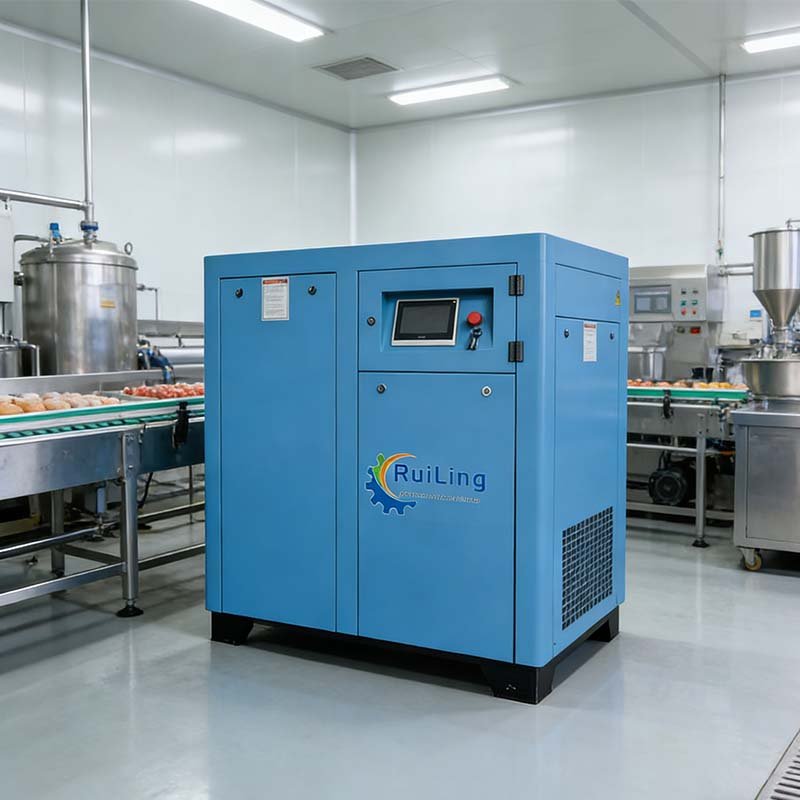
Advantage Three: Energy Efficiency Reduces Operating Costs
Food processing consumes significant energy, and compressed air systems represent a substantial portion of that consumption. Screw compressors help reduce these costs.
Variable Speed Drive Technology
Many modern Screw Air Compressors incorporate variable frequency drives (VFD) that adjust motor speed to match real-time air demand. During periods of lower production—such as shift changes or cleaning breaks—the compressor slows down and consumes less energy. This on-demand operation eliminates the energy waste of fixed-speed units that run at full capacity regardless of actual need.
Lower Operating Temperatures
Screw compressors operate at lower internal temperatures than piston alternatives. This efficiency means less energy converts into waste heat and more converts into useful compressed air. The reduced heat also extends component life, reducing maintenance costs.
Integrated Systems Save Space and Energy
The 4-in-1 air compressor concept—combining the compressor, tank, dryer, and filters into a single unit—offers additional efficiency benefits. Integrated systems minimize pressure drops between components, reducing the energy required to deliver air to the point of use. They also reduce installation complexity and footprint, which matters in facilities where floor space is at a premium.
Advantage Four: Durability and Low Maintenance
Food production environments present challenges beyond those of general industry. Washdowns, humidity, and temperature variations stress equipment. Screw compressors handle these conditions well.
Robust Construction
An industrial air compressors unit designed for food production includes features that extend service life. Stainless steel components resist corrosion from washdowns. Sealed enclosures protect internal parts from moisture and cleaning chemicals. Heavy-duty filters handle the higher dust loads common in facilities that process dry ingredients like flour or spices.
Fewer Wearing Parts
Screw compressors have fewer moving parts than piston units. There are no valves, piston rings, or wrist pins to replace. The two rotors spin continuously without impact forces. This design simplicity translates into fewer breakdowns and lower maintenance costs over the equipment’s life.
Predictable Service Intervals
With proper oil analysis and filter monitoring, food facilities can schedule maintenance predictably. This predictability allows production managers to plan service during scheduled downtime, avoiding unplanned interruptions during production runs. The result is higher overall equipment effectiveness and better production planning.
Choosing the Right Screw Air Compressor for Your Facility
Not every screw compressor suits every food application. Selection depends on your specific needs.
Match Air Quality to Your Process
Determine whether your application requires oil-free air. Direct contact with food demands oil-free technology. Non-contact applications may tolerate trace oil from lubricated units. Be honest about your requirements—over-specifying wastes money, while under-specifying risks product safety.
Consider Your Duty Cycle
If your facility runs continuous production, choose a unit rated for 100% duty cycle. If production occurs in batches with significant idle periods, you may benefit from variable speed technology that reduces energy use during low-demand periods.
Plan for Integration
Your compressor does not work alone. It functions within a complete Air compression system that includes dryers, filters, and storage. Select components that work together seamlessly. Consider an integrated 4-in-1 air compressor package if space or installation simplicity matters.
Verify Certifications
Food facilities require equipment that meets industry standards. Look for compressors certified for food-grade applications. Verify that the manufacturer follows good manufacturing practices and can provide documentation for audits.
Conclusion
Screw Air Compressors deliver clear advantages for food production facilities. Their continuous operation capability keeps production lines moving through long shifts. Their air quality options—including oil-free designs—help facilities meet strict food safety standards. Their energy efficiency reduces operating costs in an industry where margins matter. Their durability and low maintenance requirements minimize downtime and service disruptions.
When selecting equipment for your facility, consider your specific air quality requirements, duty cycle, and integration needs. Pair your compressor with appropriate drying and filtration to ensure clean, dry air. Whether you choose a standard lubricated unit or an Oil-free screw air compressor, the reliability and efficiency of screw technology make it the preferred choice for food production. With proper selection and maintenance, your industrial air compressors system will provide dependable service for years, protecting product safety and supporting efficient operations.