
Walk into any industrial facility, and you will likely hear one humming in the background. Common Air Compressors come in various shapes and sizes, each designed for specific tasks and environments. From small auto repair shops to huge offshore vessels, these machines provide air power that keeps modern industry moving. Understanding the differences between them helps you select the right equipment for your operation.
Before we explore individual types, let us look at what all compressors share in common.
What All Compressors Do
Every pneumatic system takes in ambient air and reduces its volume, which increases its pressure. The machine then stores this compressed air or delivers it directly to tools and equipment. However, the method of compression varies significantly between designs.
Some use pistons moving up and down in cylinders. Others employ rotating screws that trap and squeeze air continuously. Each approach offers distinct advantages for different applications.
Now that we understand the basic principle, let us examine the most widely used designs.
Piston Type: The Workhorse of Common Air Compressors
The reciprocating piston design represents one of the oldest and most widely used technologies.
How Piston Units Work
A Piston Air Compressor uses a motor-driven piston moving inside a cylinder. On the downstroke, the piston draws air into the cylinder through an intake valve.
On the upstroke, it compresses that air and forces it out through a discharge valve. Single-stage models achieve pressures up to 125 PSI. Two-stage units reach 175 PSI or higher.
Applications of Piston Air Compressors
The applications of piston air compressors span numerous industries due to their versatility and lower initial cost. Auto repair shops use them to power impact wrenches and tire inflators. Construction crews rely on portable versions for framing nailers and roofing tools.
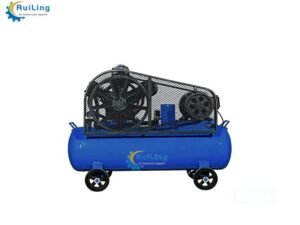
Small manufacturing operations use them for cleaning stations and pneumatic controls. These units excel at intermittent duty cycles where air demand fluctuates throughout the day.
Advantages and Limitations
Piston units cost less upfront than most alternatives. They tolerate harsh environments well and require relatively simple maintenance. However, they operate louder than rotary designs and cannot run continuously without overheating. For 24/7 operation, a different technology usually works better.
From reciprocating designs, let us move to the technology that dominates continuous-duty applications.
Rotary Screw: The Continuous-Duty Standard
When operations run around the clock, rotary screw technology typically takes the lead.
The Role of the Screw Compressor Rotor
At the heart of these machines lies a precisely machined screw compressor rotor set. A male rotor and a female rotor interlock and spin together. As they rotate, air moves along the axis from the inlet to the discharge.
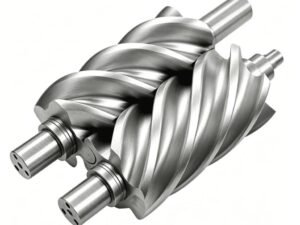
The space between the rotors progressively decreases, compressing the trapped air. This continuous process delivers smooth, pulse-free flow without the vibration common to piston designs.
Why Industries Choose Rotary Screw
Facilities with consistent air demand prefer rotary screw units because they run 24/7 without overheating. They operate more quietly than piston machines and deliver higher efficiency over long periods. A typical industrial air compressor in a factory setting often uses rotary screw technology for these reasons.
Oil-Injected vs. Oil-Free Versions
Oil-injected rotary screw units introduce oil into the compression chamber for lubrication, sealing, and cooling. You must remove this oil before the air reaches sensitive tools. For applications requiring absolutely no oil contamination, manufacturers offer oil-free versions. These use coated screw compressor rotor sets and timing gears to prevent metal-to-metal contact without liquid lubricant.
Having covered the two most common land-based designs, let us consider a specialized environment.
Marine Air Compressor: Built for the Sea
Operating at sea presents challenges that land-based facilities never face. Saltwater corrodes standard components within weeks. Constant rolling and pitching stress mechanical connections. Space comes at a premium on any vessel.
Unique Features of Marine Units
A marine air compressor addresses these challenges through robust construction. Stainless steel or coated components resist saltwater corrosion. Reinforced mounts withstand constant vibration. Compact designs fit within tight engine rooms.
Many units also include special air dryers because marine air contains high humidity that causes corrosion throughout the system.
Critical Applications Aboard Vessels
Compressed air serves multiple essential functions on ships. Large marine diesel engines require high-pressure air—typically 300 PSI or more—to start. Pneumatic controls operate valves and automation systems.
Deck crews use compressed air for tools and cleaning. Without a reliable marine air compressor, a vessel cannot safely operate.
Now let us look at the highest standard of air purity available.
Class Zero: The Purity Standard
Some applications cannot tolerate any oil contamination whatsoever. For these sensitive environments, manufacturers produce specialized equipment meeting strict certification standards.
What Class Zero Means
Class zero air screw compressors represent the highest standard for oil-free compression. This certification means the compressed air contains no measurable oil contamination. Independent testing verifies that these units meet the stringent requirements.
Where Class Zero Matters
Industries requiring class zero air screw compressors include pharmaceutical manufacturing, where oil would contaminate drugs. Electronics assembly needs oil-free air to prevent defects on circuit boards. Food and beverage processing demands purity for product safety. In these applications, even trace amounts of oil prove unacceptable.
How They Achieve Zero Contamination
These units use screw compressor rotor sets with permanent coatings like PTFE. Timing gears ensure the rotors never touch each other or the housing. Water or specialized coatings provide cooling and sealing instead of oil. The result is compressed air that contains no hydrocarbon contaminants.
With all these options available, how do you choose the right one?
Selecting Among Common Air Compressors
Choosing the right equipment requires matching technology to your specific needs.
Consider Your Duty Cycle
Intermittent use with frequent starts and stops suits piston units well. Continuous 24/7 operation demands rotary screw technology. Matching the design to your duty cycle prevents premature failure.
Evaluate Air Quality Requirements
General shop air usually tolerates trace oil from standard lubricated units. Painting, food processing, or electronics work may require oil-free or class zero certification. Be honest about your purity needs—over-specifying wastes money, while under-specifying creates quality problems.
Assess Your Environment
Clean indoor facilities offer flexibility. Dusty construction sites need robust intake filtration. Marine environments demand corrosion-resistant construction. Your operating conditions should drive your selection.
Factor in Space and Power
Piston units typically require more floor space relative to their output. Rotary screw designs offer compact footprints. Marine units prioritize space efficiency above all. Check electrical requirements too—larger machines often need three-phase power.
Maintenance Considerations for Each Type
Different designs demand different maintenance approaches.
For Piston Air Compressor units, focus on valve inspections, belt changes, and cylinder wear checks. For rotary screw designs, prioritize oil changes, filter replacements, and separator element monitoring. A marine air compressor requires additional attention to corrosion prevention and moisture control. Class zero air screw compressors need regular coating inspections and timing gear checks.
No matter which type you choose, consistent upkeep remains essential.
Conclusion
Common Air Compressors fall into several distinct categories, each suited to specific applications and environments. Piston units offer low initial cost and work well for intermittent duty. Rotary screw designs dominate continuous operation, with the screw compressor rotor enabling efficient, pulse-free compression.
Applications of piston air compressors span auto repair, construction, and small manufacturing. A marine air compressor withstands the harsh conditions of shipboard service. For the highest air purity requirements, class zero air screw compressors deliver oil-free compression verified by independent testing.
Understanding these differences helps you select the right equipment for your operation. Match the technology to your duty cycle, air quality needs, and operating environment. With the right choice, your Common Air Compressors will provide reliable pneumatic power for years to come.
Our Facebook;https://www.facebook.com/rlaircompressor